
Front Matter
Publication Details
International Safety Guide for Oil Tankers and Terminals (ISGOTT)
Sixth Edition
First published 1978; Second Edition 1984; Third Edition 1988; Third Edition Revised 1991; Fourth Edition 1996; Fifth Edition 2006; Sixth Edition 2020.
© International Chamber of Shipping, London
and
© Oil Companies International Marine Forum, Bermuda
1978, 1984, 1988, 1991, 1996, 2006, 2020
Book ISBN: 978-1-85609-918-9
eBook ISBN: 978-1-85609-919-6
British Library Cataloguing in Publication Data
A catalogue record for this book is available from the British Library.
Sponsoring Organisations

International Chamber of Shipping (ICS)
The International Chamber of Shipping (ICS) is the principal international trade association for the shipping industry, representing shipowners and operators in all sectors and trades.
ICS membership comprises national shipowners' associations in Asia, Europe and the Americas whose member shipping companies operate over 80% of the world's merchant tonnage.
Established in 1921, ICS is concerned with all technical, legal, employment affairs and policy issues that may affect international shipping. It represents shipowners with the various intergovernmental regulatory bodies that impact on shipping, including the International Maritime Organization (IMO).
ICS also develops best practices and guidance, including a wide range of publications and free resources that are used by ship operators globally.

Oil Companies International Marine Forum (OCIMF)
Founded in 1970, the Oil Companies International Marine Forum (OCIMF) is a voluntary association of oil companies having an interest in the shipment and terminalling of crude oil, oil products, petrochemicals and gas, and includes companies engaged in offshore marine operations supporting oil and gas exploration, development and production.
Our vision is a global marine industry that causes no harm to people or the environment.
Our mission is to lead the global marine industry in the promotion of safe and environmentally responsible transportation of crude oil, oil products, petrochemicals and gas, and to drive the same values in the management of related offshore marine operations. We do this by developing best practices in the design, construction and safe operation of tankers, barges and offshore vessels and their interfaces with terminals and considering human factors in everything we do.

International Association of Ports and Harbors (IAPH)
Founded in 1955, the International Association of Ports and Harbors (IAPH) is a non-profit-making global alliance of 170 ports and 140 port-related organisations covering 90 countries. Its member ports handle more than 60 percent of global maritime trade and around 80 percent of world container traffic. IAPH has consultative NGO status with several United Nations agencies. In 2018, IAPH established the World Ports Sustainability Program (WPSP). Guided by the 17 UN Sustainable Development Goals, it aims to unite sustainability efforts of ports worldwide, encouraging international cooperation between all partners involved in the maritime supply chain. WPSP (sustainableworldports.org) covers five main areas of collaboration: energy transition, resilient infrastructure, safety and security, community outreach and governance.
Notice of Terms of Use
While the information and advice given in this guide (ISGOTT International Safety Guide for Oil Tankers and Terminals) has been developed using the best information currently available, it is intended purely as guidance to be used at the user's own risk. No warranties or representations are given nor is any duty of care or responsibility accepted by the International Chamber of Shipping (ICS), the Oil Companies International Marine Forum (OCIMF), the International Association of Ports and Harbors (IAPH), the members or employees of ICS, OCIMF, IAPH or by any person, firm, company or organisation who or which has been in any way concerned with the furnishing of information or data, the compilation or any translation, publishing, supply or sale of the guide, for the accuracy of any information or advice in the guide or any omission from the guide or for any consequence whatsoever resulting directly or indirectly from compliance with, adoption of, or reliance on guidance contained in the guide even if caused by failure to exercise reasonable care.
Publisher
Published by Witherby Publishing Group Ltd
Navigation House
3 Almondvale Business Park
Almondvale Way
Livingston EH54 6GA
Scotland, UK
+44 (0)1506 463 227
info@witherbys.com
witherbys.com
Printed and bound in Great Britain by Trade Colour Printing, Penrith, UK.
Foreword
I am very pleased to introduce the revised Sixth Edition of the International Safety Guide for Oil Tankers and Terminals, or ISGOTT as it is generally known throughout the global tanker industry and amongst the Member States of the UN International Maritime Organization (IMO).
ISGOTT, first published in 1978, is now widely recognised as the definitive best practice guidance on tanker safety and pollution prevention, and is a perfect example of the good cooperation that exists between the IMO and the shipping industry the Organization regulates. The authors of this major publication - the International Chamber of Shipping (ICS), the Oil Companies International Marine Forum (OCIMF) and the International Association of Ports and Harbors (IAPH) - all enjoy consultative status with the IMO and contribute significantly to its work through their active participation at IMO meetings.
I believe that a reason why ISGOTT has endured, and is so highly regarded, is the vital complementary role it plays in working alongside the comprehensive framework of global shipping regulation that has been adopted by the IMO to help ensure safe and pollution-free ship operations.
Global maritime regulations, enforced by Flag States, are vital for ensuring that all ships, regardless of flag, can operate safely and efficiently wherever in the world they are trading. However, further detailed guidance on best operational practice is leveraged from the vast experience of industry professionals. Industry publications such as ISGOTT are therefore crucial for ensuring that the aims and objectives of IMO instruments, such as the MARPOL and SOLAS Conventions, are achieved in real life.
The safety record and the environmental performance of the tanker industry has improved substantially since the adoption by the IMO of its many Conventions and Codes. This impressive improvement in performance has not been delivered by regulation alone. It is a testimony to the good practices deployed, and constantly refined, by the industry itself and the dedication and huge professionalism of the seafarers and other personnel it employs.
This firm commitment by the industry to continuous improvement is a concept fully embraced by the IMO's ISM Code, and I believe this is clearly demonstrated by the industry's ongoing efforts to keep ISGOTT updated.
I fully support the industry-wide collaboration that has made this new edition of ISGOTT possible. This is crucial to ensuring that the maritime industry will not only contribute to maintaining and further improving its excellent safety record and reducing its environmental impact, but will also bring us ever closer to the ultimate goal of zero accidents.
Kitack Lim
Secretary-General
International Maritime Organization
Introduction to the Sixth Edition
Effective management of health, safety and environmental protection is critical to the tanker and terminal industry and the International Safety Guide for Oil Tankers and Terminals (ISGOTT) has become the standard reference on the safe operation of oil tankers and the terminals they serve.
ISGOTT was first published in 1978 by combining the contents of the Tanker Safety Guide (Petroleum) published by the International Chamber of Shipping (ICS) and the International Oil Tanker and Terminal Safety Guide published on behalf of the Oil Companies International Marine Forum (OCIMF). This revision of ISGOTT updates and replaces the prior Fifth Edition that was published in 2006 and has been reviewed by OCIMF and ICS together with the International Association of Ports and Harbors (IAPH). In addition, support has also been provided by other industry associations including the International Association of Independent Tanker Owners (INTERTANKO), the Society of International Gas Tanker and Terminal Operators (SIGTTO) and the Society for Gas as a Marine Fuel (SGMF), as well as specialists in topics such as human factors.
Through the combined effort of multidisciplinary subject matter experts from these industry leading organisations, this publication has been enhanced to ensure that it continues to reflect current best practice and legislation and, as a result, will maintain its position as a definitive reference for the safe operation of oil tankers and the marine terminals they visit.
This Sixth Edition encompasses the latest thinking on a range of topical issues including gas detection, the toxicity and the toxic effects of petroleum products (including benzene and hydrogen sulphide), the generation of static electricity and stray currents, fire protection and the growing use of mobile electronic technology.
In addition, the opportunity was taken to include new topics or to significantly reappraise topics previously covered that have undergone a shift in emphasis since the Fifth Edition. These include:
- Enclosed space entry.
- Human factors.
- Safety Management Systems (SMSs), including complementary tools and processes such as permits to work, risk assessment, Lock-out/Tag-out (LO/TO), Stop Work Authority (SWA) and their linkage to the underlying principles of the International Safety Management (ISM) Code.
- Marine terminal administration and the critical importance of the tanker/terminal interface.
- Alternative and emerging technologies.
- Bunkering operations, including the use of alternative fuels such as Liquefied Natural Gas (LNG).
- Cargo inspectors.
- Alignment with OCIMF's recently revised Mooring Equipment Guidelines.
- Maritime security and linkage to both the International Ship and Port Facility Security (ISPS) Code and industry's maritime security Best Management Practices (BMP).
The Ship/Shore Safety and Bunkering Operations Checklists have also been completely revised to reflect changes in the understanding of the impact of human factors in their effective use. The importance of ensuring that individual and joint responsibilities for the tanker and the terminal are clearly communicated before arrival, as well as when alongside, is central to this objective.
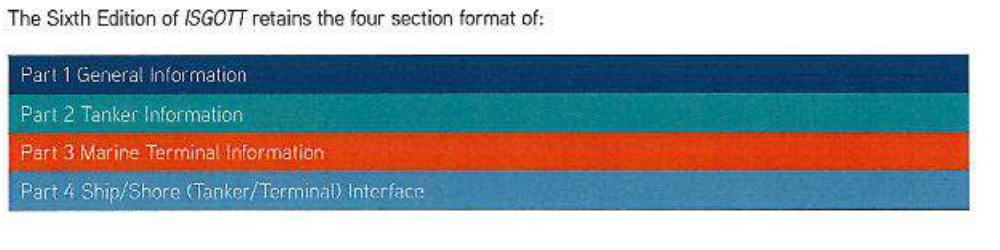
The Sixth Edition of ISGOTT retains the four section format of:
Care has been taken to ensure that where the guidance given in previous editions is still relevant and accurate, any amendments, changes or deletions have only enhanced the content and not diminished the ethos of ensuring the health, safety and environmental protection of those who use the guide.
Purpose and Scope
The primary purpose of the International Safety Guide for Oil Tankers and Terminals (ISGOTT) is to provide operational advice to assist personnel directly involved in tanker and terminal operations. It makes recommendations for tanker and terminal personnel on the safe carriage and handling of crude oil and petroleum products on tankers and at terminals. It does not, however, provide a definitive description of how tanker and terminal operations are conducted.
To achieve its purpose ISGOTT provides guidance on, and examples of, certain aspects of tanker and terminal operations and how they may be managed. Effective management of risk demands SMSs, processes and controls and procedures that can quickly adapt to change. Therefore, the guidance given is, in many cases, intentionally non-prescriptive and alternative procedures may be adopted by operators in the management of their operations. These alternative procedures may exceed the recommendations contained in this guide and are strongly encouraged where they will further enhance the safety objective.
When adopting alternative procedures, operators should follow a risk-based management process that incorporates systems for identifying and assessing the risks and for demonstrating how they are safely managed. Guidance in the Sixth Edition is aimed at further assisting operators of tankers and marine terminals in these principles of safe management. For shipboard operations, this course of action must satisfy the requirements of the ISM Code.
In all cases, the advice given in ISGOTT is subject to any international, national or local regulations that may be applicable and is intended only to complement or strengthen those requirements. Companies responsible for the operation of tankers and terminals should ensure that they are aware of any such requirements and ensure full compliance.
It is recommended that a copy of ISGOTT is kept and used on board every tanker and in every marine terminal to provide advice on operational procedures and the shared responsibility for operations at the ship/shore interface.
Certain subjects are dealt with in greater detail in other publications issued by the IMO, ICS or OCIMF or by other maritime industry organisations. Where this is the case, an appropriate reference is made and a list of these publications is given in the bibliography.
It is not the purpose of the guide to make recommendations on design or construction of tankers. Information on these matters may be obtained from national authorities and from authorised bodies such as Classification Societies. Similarly, the guide does not attempt to deal with certain other safety related matters, e.g. navigation, helicopter operations and shipyard safety, although some aspects are inevitably touched upon.
It should also be noted that the scope of ISGOTT relates only to cargoes of crude oil and petroleum products that are carried in oil tankers, chemical tankers, gas carriers and combination carriers certified for the carriage of petroleum products. Therefore, it does not cover the carriage of chemicals or liquefied gases other than in the context of where they may be used on board oil tankers, e.g. LNG as a marine fuel. The carriage of chemicals and gases as cargo are the subject of other industry guides.
Industry guidance such as ISGOTT is based on the best knowledge and information available to the authors. Irrespective of this and the subject matter, or how strong and important the information provided, the industry is not in a position to mandate its own advice. For this reason, industry guidance in ISGOTT is characterised by the word 'should'. IMO regulations implemented by national administrations are legally enforceable and, therefore, when ISGOTT references such regulations or their implications the term used is 'must'.
Finally, the guide is not intended to encompass offshore facilities such as Floating Production Storage and Offloading Units (FPSOs) and Floating Storage Units (FSUs); operators of such units may, however, wish to consider the guidance given to the extent that good tanker practice is equally applicable to their operations.
Comments and Contact Details
Comments and suggestions for improvement are always welcome for possible inclusion in future editions. They may be addressed to any of the three sponsoring organisations as follows:
International Chamber of Shipping
38 St Mary Axe
London
EC3A 8BH
United Kingdom
Web: www.ics-shipping.org
Oil Companies International Marine Forum
29 Queen Anne's Gate
London
SW1H 9BU
United Kingdom
Web: www.ocimf.org
International Association of Ports and Harbors
7th Floor
South Tower New Pier Takeshiba
1-16-1 Kaigan
Minato-ku
Tokyo 105-0022
Japan
Web: www.iaphworldports.org
No comments to display
No comments to display