
3. TDI Products
TDI Production Process
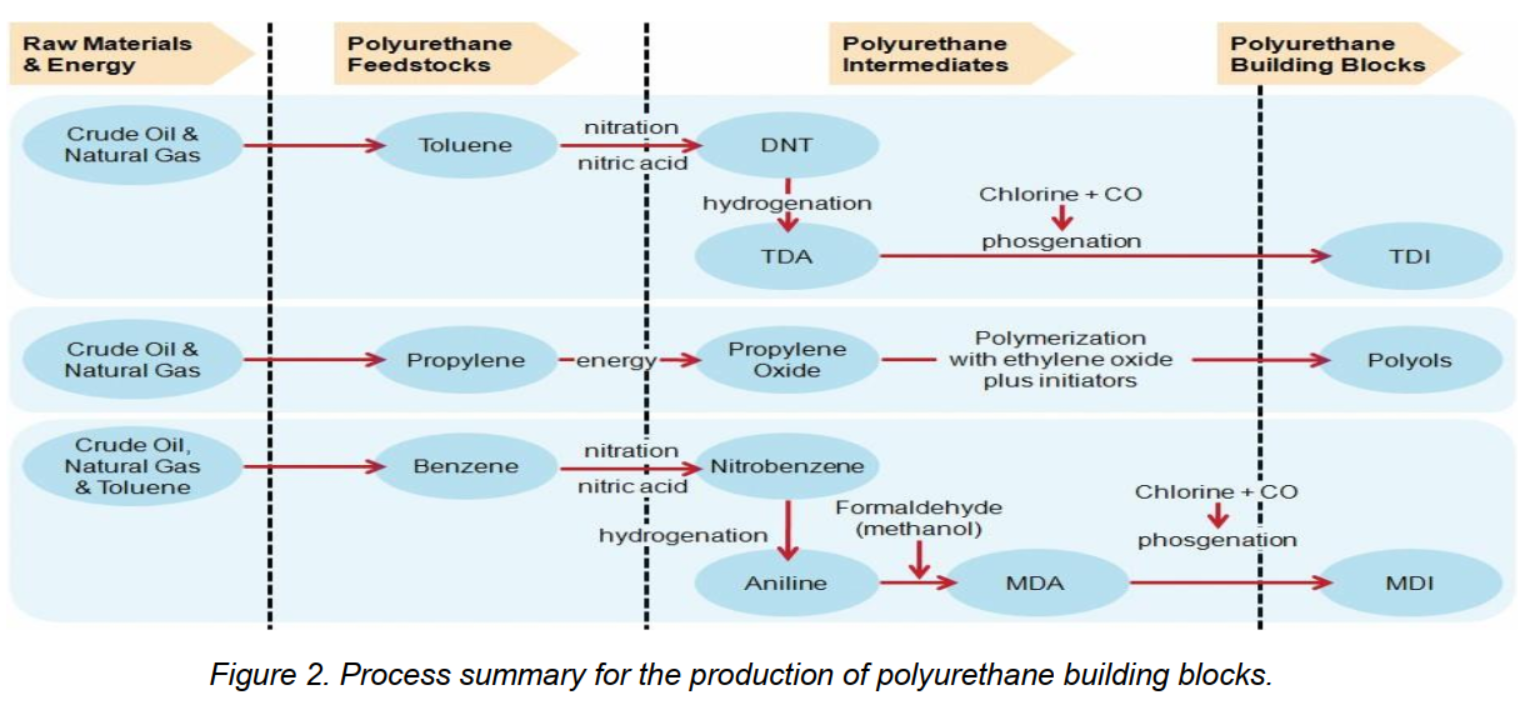
In the TDI process, toluene diamine (TDA) is manufactured by the catalytic reaction of dinitrotoluene (DNT). TDA is then reacted with phosgene (carbonyl chloride) to produce toluene diisocyanate (TDI). Figure 2 gives a summary of the MDI, TDI, and polyether production process.
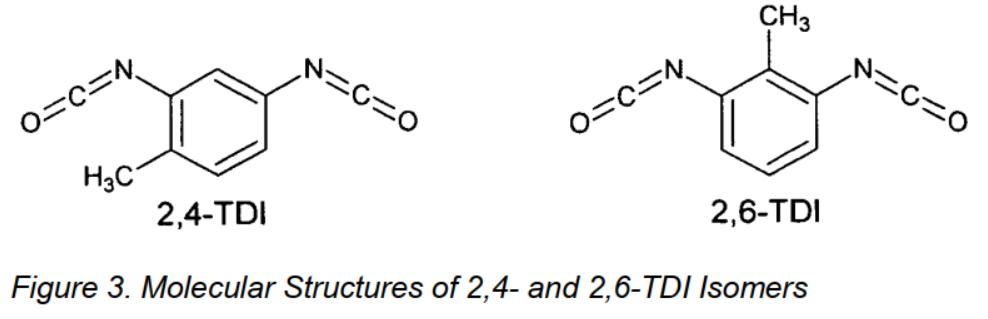
TDI by BASF is an 80:20 mixture of the 2,4- and 2,6-TDI isomers assaying 99.5% TDI minimum, as shown in Figure 3. TDI is produced in several grades that differ slightly in acidity and hydrolyzable chloride content. Increased acidity of TDI allows broader processing latitude in some applications. Type I is used in flexible slab polyurethane foam and Type II is used primarily in coating, adhesive, sealant, and elastomer (CASE) applications wherever an intermediate prepolymer is produced.
Properties of TDI
TDI is denser than water and will sink to the bottom of water-filled containers. Although it reacts exothermically with water, the rate of reaction is very slow at temperatures below 50°C (122°F). At higher temperatures, the reaction becomes progressively more vigorous and can be violent. The reaction of TDI with water forms both carbon dioxide (CO2) and insoluble polyurea compounds. Even small quantities of water may produce enough CO2 to rupture sealed containers. Figure 4 provides a list of physical properties of TDI. The current safety data sheet (SDS) should be used in conjunction with this publication.
Table 1. Physical properties of Toluene Diisocyanate.
| Chemical Name |
Toluene Diisocyanate 2,4-Toluene Diisocyanate 2,6-Toluene Diisocyanate |
CAS No. 26471-62-5 CAS No. 584-84-9 CAS No. 91-08-7 |
| Synonyms |
TDI, Toluene Diisocyanate | |
| Molecular Formula | CH3 C6 H3 (NCO)2 | |
| Molecular Weight | 174.2 | |
| Appearance | Clear, Colorless Liquid | |
| Odor | Strong, Pungent | |
| NCO Content (wt%) | 48.2 | |
| Specific Gravity at 25°/25°C (77°/77°F) | 1.22 | |
| Density (pounds/gallon) | 10.2 lb/gal = ~ 1.22 kg/L | |
| Viscosity (mPa s, cps) at 20°C (68°F) | 3.2 | |
| Boiling Point at | 10 mm Hg 760 mm Hg |
120°C (248°F) 250°C (482°F) |
| Vapor Density (Air=1) | 6 |
|
| Vapor Pressure | mm Hg at 25°C (77°F) mm Hg at 35°C (95°F) mm Hg at 45°C (113°F) |
0.025 0.056 0.120 |
|
For reference: Vapor pressure of Ethanol @ 25°C = 60 mm Hg = 7.9 kPa = 0.078 atm Vapor pressure of Hexane @ 25°C = 151 mm Hg = 20.1 kPa = 0.199 atm Vapor pressure of Acetone @ 25°C = 231 mm Hg = 30.9 kPa = 0.304 atm |
||
| Specific Heat |
J/g K at 20°C (68°F) J/g K at 100°C (212°F) |
1.46 1.71 |
| Heat of Evaporation | J/g at 120°C (248°F) J/g at 180°C (356°F) |
369 365 |
| Flash Point (DIN) | 135°C (275°F) | |
| Flammability Limits (V/V in air) |
LEL 0.9% UEL 9.5% |
|
| Solubility in Water | Not soluble; reacts with evolution of CO2 | |
TDI reacts with basic materials such as sodium hydroxide, ammonia, primary and secondary amines, and with acids and alcohols. Reactions with some of these products may be violent, generating heat, which can result in an increased evolution of TDI vapor and the formation of CO2.
In general, TDI is not corrosive towards metals or other materials at room temperature. However, small amounts of rust or iron from mild steel containers may affect product quality. Mild steel storage containers can be lined to prevent discoloration.
TDI will attack many plastics and rubber materials and make them brittle. Hoses made of these materials may experience cracking after only minimal usage.
No comments to display
No comments to display