
2. Introduction
Toluene diisocyanate (TDI) is a member of the diisocyanate family associated with polyurethane chemistry. The term polyurethane applies to a large number of polymers formed through the polyaddition of polyfunctional isocyanates and isocyanate-reactive polyfunctional compounds. Polyurethanes are some of the most versatile polymers in existence today. They exist in numerous forms ranging from lightweight rigid foams to dense solid compositions and from soft flexible foams to tough elastomeric moldings.
BASF Commitment to the Polyurethane Industry
The worldwide polyurethane operations of the BASF Group include a broad range of activities such as:
- Urethane chemicals
- Diphenylmethane diisocyanate (MDI)
- Toluene diisocyanate (TDI)
- Polyols (polyether, polyester)
- Polyurethane systems
- Polyurethane elastomers / thermoplastics
- Microcellular polyurethanes
These activities are coordinated on a global basis to assure a high level of quality to polyurethane
processors and users throughout the world.
Since its founding in 1865, BASF SE has placed major emphasis on research and development. Today, the results of widely based research activities in Europe and North America are directly available to all independently operating companies in the BASF Group. This constant interchange of technical expertise among businesses in the BASF Group ensures that BASF customers will benefit from the very latest knowhow of polyurethane technology within the Group. Figure 1 illustrates the worldwide geographic spread of BASF
Group products.
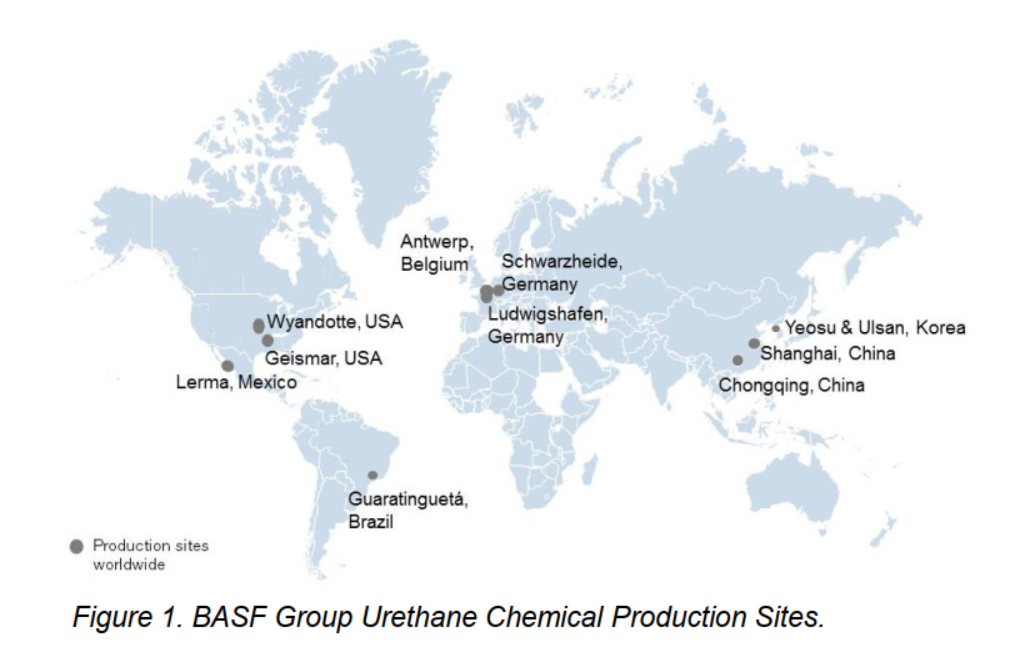
BASF manufactures and markets three of the key urethane chemicals: MDI, TDI, and Polyols. TDI is produced in Geismar, LA, U.S.A.; Ludwigshafen and Schwarzheide, Germany; Yeosu, Korea; and Shanghai, China.
The trademark for BASF TDI is Lupranate® T80. TDI is an important chemical building block in a wide variety of polyurethane applications. Its most important use is in the production of flexible polyurethane foams for furniture, bedding, carpet underlay, and automotive seating. TDI is also used in the production of adhesives, coatings, sealants, and elastomers (CASE).
Like many reactive chemicals, TDI products1 can create hazards if handled carelessly. The purpose of this publication is to outline certain precautions, the observance of which will reduce these hazards in handling diisocyanates under normal and emergency situations. All persons associated with the transportation, storage, or handling of TDI or products containing TDI, must be thoroughly familiar with the potential hazards and trained in the recommended normal and emergency handling procedures.
This publication is only intended to provide general guidance, and for the area of North America. In some countries, specific regulations supplement or modify the guidance given herein. All users of TDI products must be fully informed of the most current guidelines and regulations of all applicable authorities. Users of TDI are strongly urged to consult the appropriate regulatory authorities before finalizing specifications for processing, handling, and storage equipment. Any technical advice furnished, or recommendation made herein is believed to be reliable, and BASF makes no warranty, either expressed or implied, as to its accuracy or completeness
or of the results to be obtained.
The current safety data sheet (SDS) should be used in conjunction with this publication because the SDS is updated as changes in regulatory requirements occur. SDSs can be obtained online (http://polyurethanes.basf.us/) or directly from your BASF representative.
No comments to display
No comments to display